

Supply Chain Management
Supporting the SDGs


Goals and Performance Highlights

2027 Target
2025 Performance

2027 Target
2025 Performance
Business Challenges and Opportunities
The Company's business operations span the entire energy ecosystem value chain, involving complex projects and multiple stakeholders from raw material suppliers and equipment manufacturers to subcontractors and logistics providers.
Consequently, the supply chain is a critical factor directly impacting project quality, continuity, and efficiency. However, relying on multi-tier suppliers and contractors poses challenges in ensuring consistent compliance with legal requirements, labor standards, human rights, and sustainability regulations. Inadequate management could lead to project delays, contract disputes, increased costs, and risks to corporate reputation and stakeholder trust. Conversely, developing a systematic approach to select, assess, and elevate the capacity of suppliers and contractors not only mitigates these risks but also presents a strategic opportunity. It establishes shared operational standards across the value chain, enhances quality control, promotes transparency, and improves traceability. This readiness strengthens the Company's capability to manage large-scale projects, engage in joint ventures, and ensure long-term credibility and competitiveness. Therefore, sustainable supply chain management serves as both a risk mitigation mechanism and a strategic tool driving business growth alongside balanced social and environmental responsibility.

Management Approach and Value Creation
Supply Chain Management Approach
The Company integrates sustainable development principles into its supply chain management by incorporating Environmental, Social, and Governance (ESG) considerations, including respect for human rights. This approach enhances the efficiency and quality of sourcing goods and services while supporting long-term sustainable outcomes. Procurement is a key strategic function of the Company. Therefore, the Company has established a Procurement Policy that emphasizes transparency, fairness, and accountability to ensure cost efficiency, sustainable resource utilization, and effective supplier risk management. The Company also promotes anti-corruption practices, business ethics, and responsible business conduct among suppliers, while supporting the development of supplier capabilities to align with sustainability standards throughout the supply chain.
In 2025, the Company strengthened its approach by developing and issuing the “Sustainable Supply Chain Management Manual.” Approved by the Executive Committee, the manual is implemented across all business units, including subsidiaries and affiliated companies, to ensure consistent practices aligned with the Company's sustainability standards. The supply chain management framework consists of the following key processes:
Selection of New Suppliers

Prioritization and Classification of Supplier Groups

Supplier Risk Assessment

Supplier Performance Evaluation

Supplier On-site Audit and Visit

Supplier Engagement and Capacity Building

Selection of New Suppliers
The Company has established a structured process for selecting new suppliers, evaluating essential business information alongside compliance with laws, regulations, and relevant standards. The assessment covers both business and sustainability considerations, including organizational credibility, technical capability, policy documentation, and ESG performance. Prior to registration on the Approved Vendor List (AVL), suppliers are evaluated using a weighted assessment framework covering five key criteria: business operations, product and service quality, delivery performance, pricing, and sustainability.
All new suppliers are required to complete the Supplier Evaluation and Selection Form. Suppliers must achieve a minimum preliminary evaluation score of 70 percent to be registered on the AVL. In addition, all new suppliers must formally acknowledge and sign the Supplier Code of Conduct.
The Company has established a Supplier Code of Conduct to serve as a shared framework for responsible practices throughout the supply chain. The Code covers environmental, social, and governance (ESG) principles, respect for human rights, and ethical business conduct. The Code is communicated to all new suppliers for acknowledgement and compliance, and is publicly accessible to all suppliers through the Company's website. The key details and relevant categories are as follows:
| Code of Conduct | |
|---|---|
| Suppliers are required to conduct business with integrity, transparency, and accountability, and comply with all applicable laws and regulations throughout the supply chain. Key expectations include: |
|
| Human Rights and Labor Practices | |
| Suppliers must respect internationally recognized human rights and ensure fair labor practices, including: |
|
| Safety and Occupational Health | |
| Suppliers are required to maintain a safe and healthy working environment in accordance with applicable laws and relevant standards to reduce the risk of accidents and injuries. This includes providing appropriate personal protective equipment (PPE), conducting safety training, establishing emergency response plans, and regularly reviewing and communicating safety measures. | |
| Environment | |
| Suppliers are expected to manage environmental impacts arising from their operations by: |
|
| Corporate Social Responsibility | |
| Suppliers should consider potential impacts on surrounding communities and society. This includes implementing safety measures to prevent community impacts, supporting local employment and procurement where appropriate, and contributing to the improvement of community well-being. | |
| Sustainable Supply Chain | |
| Suppliers are encouraged to communicate and cascade these principles to their own suppliers and business partners, promoting responsible practices and strengthening sustainability standards throughout the supply chain. | |
The Supplier Code of Conduct is integrated into the Company’s procurement policy and contractual requirements. Suppliers are expected to comply with these requirements throughout their engagement with the Company. In cases of non-compliance, the Company may implement corrective actions, monitor improvement progress, or review the supplier’s status as appropriate.
Prioritization and Classification of Supplier Groups
Criteria for Classifying Key Suppliers
The Company categorizes, analyzes and prioritizes suppliers based on established criteria, considering 3 main factors: impact on core projects, availability of alternatives and price and quality risks. Suppliers are divided into 4 main groups: Critical Tier 1 Supplier, Tier 1 Supplier, Critical Non-Tier 1 Supplier and Affiliated Company, according to the following criteria:
| Supplier Group | Supplier Classification Criteria |
|---|---|
| Critical Tier 1 Supplier | |
| Critical Tier 1 Supplier |
|
| Tier 1 Supplier | |
| Tier 1 Supplier |
|
| General Supplier |
|
| Critical Non-Tier 1 Supplier | |
| Critical Non-Tier 1 Supplier |
|
| Affiliated Company | |
| Affiliated Company |
|
In 2025, the Company engaged with a total of
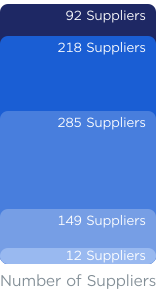
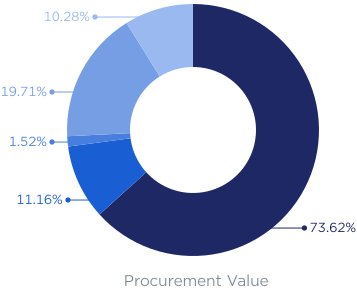
In 2025, the Company engaged with a total of 756 suppliers, comprising 92 Critical Tier 1 Suppliers, 218 Tier 1 Suppliers, 285 Tier 1 Suppliers - General Suppliers, 149 Critical Non-Tier 1 Suppliers, and 12 Affiliated Companies. The Company communicated the Supplier Code of Conduct to ensure acknowledgment and compliance among its suppliers. As a result, 100% of Critical Tier 1 Suppliers and 33.99% of all suppliers were formally informed of and aligned with the Supplier Code of Conduct.
Supplier Risk Assessment
The Company places strong emphasis on supply chain risk management to mitigate potential impacts on operational costs, business continuity, and corporate reputation arising from factors such as raw material price volatility or non-compliance with applicable laws and standards. To manage these risks effectively, the Company conducts supplier risk assessments at least once every three years, covering 100% of Critical Tier 1 Suppliers. The assessment is carried out using appropriate methodologies, including ESG Self-Assessment Questionnaires, on-site visits or audits, and monitoring information from credible external sources. The assessment results are used to strengthen risk control measures and support continuous supplier development.
Supplier Risk Identification
Sustainability-related risks associated with suppliers are assessed across economic, social, and environmental dimensions for both new and existing suppliers. The assessment covers various supplier categories, including product vendors, contractors and subcontractors, service providers, logistics and transportation providers, as well as EPC contractors and operation and maintenance (O&M) contractors involved in energy and construction projects. The assessment considers the following key risk factors:
| Risk Category | Example of Risk Factors |
|---|---|
| Product/Service Risk |
|
| Business Operation Risk |
|
| Environmental Risk |
|
| Social Risk |
|
Supplier Risk Assessment Criteria
The Company evaluates risks across 2 dimensions: Likelihood and Impact, covering operations, labor, reputation, finance, legal compliance, and environmental compliance. Data from self-assessments, past performance, news, and industry risk trends are mapped onto a Risk Matrix to calculate the risk score (Likelihood x Impact). Risks are categorized into 4 levels: Low, Moderate, High, and Very High. High and Very High-risk suppliers are subject to stringent control measures, while Low and Moderate-risk suppliers are continuously monitored to prevent risk escalation.
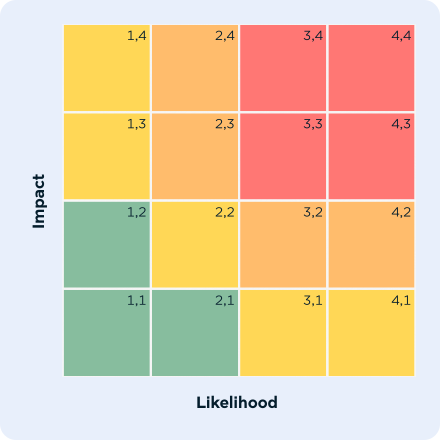
| Risk Score (Likelihood x Impact) | Risk Level | Action When Identified |
|---|---|---|

Score 1-2 |
Low Risk | Continuous monitoring to maintain or reduce risk levels. |

Score 3-4 |
Moderate Risk | Continuous monitoring to maintain or reduce risk levels. |

Score 5-8 |
High Risk | Establishment of control measuresto mitigate risks. |

Score 9-16 |
Very High Risk | Establishment of control measures to mitigate risks |

For the suppliers identified as High Risk, the Company collaborated with them to establish control and monitoring measures to appropriately improve and mitigate their risk levels. These actions include implementing a Corrective Action Plan (CAP), closely tracking progress, and conducting follow-up audits within specified timeframes to ensure their operations comply with the Company's requirements and standards.
Supplier Performance Evaluation
The Company requires Critical Tier 1 Suppliers to report environmental, social, and governance (ESG) information as part of the supplier performance evaluation process. The assessment covers material sustainability issues that may affect business operations, including corporate social responsibility, human rights and labor practices, occupational health and safety, environmental management measures, and the provision of environmentally friendly products or services. The information collected is used to monitor supplier performance and provide recommendations to support continuous improvement. All registered suppliers are subject to an annual performance evaluation using established assessment tools, including Evaluation Forms (Vendor and Contractor Evaluation) and the Supplier Sustainability Self-Assessment questionnaire. The evaluation process may also include performance monitoring during project execution and on-site audits, in accordance with the Company's established criteria.
Supplier Performance Evaluation Criteria
| Supplier Performance | Example of Evaulation Criteria |
|---|---|
| Economic |
|
| Social |
|
| Environment |
|
| Level | Score (%) |
|---|---|
| A = Excellent | More than or equal to 80 |
| B = Good | 70-79 |
| C = Fair | 60-69 |
| D = Improvement needed | 50-59 |
| F = Removed from Approved Vendor List (AVL) | Less than 50 |

The supplier performance evaluation process is conducted in parallel with monitoring compliance with the Supplier Code of Conduct. Evaluation results are communicated to suppliers to support operational improvements and to jointly develop supplier capacity-building or improvement plans, thereby promoting responsible and sustainable business practices throughout the supply chain. In 2025, the Company conducted ESG-based supplier performance evaluations for 43.25% of suppliers within the assessment scope, with the majority of suppliers achieving "Good" or "Excellent" performance ratings.
Supplier On-site Audit and Visit
Criteria for On-site Audits and Visits
The Company conducts supplier on-site audits at least once per year for Critical Tier 1 Suppliers that are newly engaged, classified as high or very high risk, or have received a "Needs Improvement" performance rating (Grade D) in the supplier performance evaluation. Audits are conducted by an audit team comprising representatives from the procurement function and specialists in safety, labor regulations, and sustainability. The audits may be carried out either through physical site visits or via online audit platforms, depending on the circumstances. The assessment covers economic, social, and environmental issues that are material to the supplier's business operations. Following the audit, suppliers are required to develop a Corrective Action Plan (CAP) within a specified timeframe, and the Company monitors the implementation progress accordingly. If suppliers fail to implement the required corrective actions, the Company may temporarily suspend procurement or business engagement with the supplier.

Critical Tier 1 Suppliers Assessed On-site
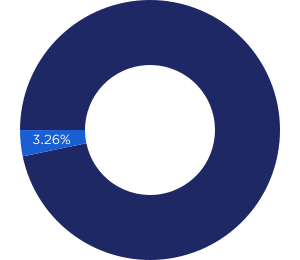
In addition, the Company maintains ongoing supplier monitoring through media and information reviews, document assessments, and random inspections when potential risk signals or non-compliance indicators are identified. During the reporting year, no significant cases of non-compliance with social or environmental requirements were identified among the suppliers assessed.
Supplier Engagement and Capacity Building
The Company recognizes suppliers as a key part of its value chain and seeks to build long-term partnerships based on transparency, trust, and mutual development. The Company encourages suppliers to align their operations with the Company's sustainability approach through communication, knowledge sharing, technical support, and ongoing performance monitoring. Key initiatives include:
Knowledge Development and Policy Integration
The Company communicates and provides training on the Procurement Policy, Supplier Code of Conduct, and ESG-based sustainable supply chain management practices to personnel involved in procurement activities. This ensures that procurement staff can systematically apply these principles in supplier selection and oversight. In addition, the Supplier Code of Conduct is integrated into the Company's procurement policy and contractual terms.
Supplier Relationship Building
The Company strengthens relationships with suppliers through training programs, communication activities, and information-sharing initiatives. The Company also organizes supplier feedback and consultation sessions to discuss collaboration, address operational challenges, and identify improvement opportunities to foster long-term partnerships.
Support for Sustainable Procurement
The Company promotes green procurement practices by prioritizing environmentally friendly products and services, including products certified with environmental labels such as the Green Label or products with low greenhouse gas (Low Carbon) emissions. The Company also collaborates with suppliers to develop environmentally friendly products and materials, such as promoting the use of recycled plastic pellets in production processes. In 2025, environmentally friendly procurement accounted for 2.49% of the total procurement value related to production activities, supporting efficient resource use and reducing environmental impacts. At the same time, the Company emphasizes local procurement, sourcing goods and services from suppliers located within the country and near operational areas. This approach supports local employment, income distribution within communities, and the reduction of transportation-related GHG emissions. In 2025, domestic procurement accounted for 81.58% of the Company's total procurement value, strengthening the resilience of the domestic supply chain and contributing to sustainable economic development.
Stakeholders Directly Impacted

Employees

Suppliers

Customers

Business Partners

