
Anti-Corruption

Supporting the SDGs


Goals and Performance Highlights

2025 Target
2025 Performance

2025 Target
2025 Performance
Business Challenges and Opportunities
Operating in the energy and infrastructure industry, which involves high-value investments, complex procurement processes, multi-party contracting, and diverse regulatory requirements, inherently presents risks of corruption that may arise at various points across the value chain. The complexity of projects, collaboration with multi-tier suppliers and contractors, and operations across multiple locations increase the challenges of effectively controlling, overseeing, and monitoring operations to ensure transparency and accountability.
If not managed with sufficient rigor, these challenges may lead to legal risks, financial losses, missed business opportunities, and damage to the corporate reputation and stakeholder confidence, including that of investors, regulators, and other key stakeholders. However, establishing a robust corporate governance framework alongside effective risk management systems creates an opportunity for anti-corruption measures to serve as a key driver of organizational competitiveness. The establishment of clear policies and preventive measures, regular corruption risk assessments, and the cultivation of an organizational culture grounded in business ethics contribute to enhanced transparency, reduced losses from adverse incidents, and strengthened confidence among investors, financial institutions, and business partners.

Furthermore, organizations with robust anti-corruption systems are better positioned to participate in large-scale investment projects and international collaborations, as they demonstrate a strong commitment to governance standards and strict adherence to applicable laws and regulations. Therefore, anti-corruption should not be viewed merely as a regulatory compliance requirement, but as an essential mechanism for risk management, strengthening corporate governance, and supporting long-term business sustainability.
Management Approach and Value Creation
Anti-Corruption Process
The Company regularly establishes and reviews relevant operational processes to identify potential weaknesses and enhance operational effectiveness. This helps reduce opportunities for misconduct and mitigate corruption risks. Key approaches are outlined as follows:
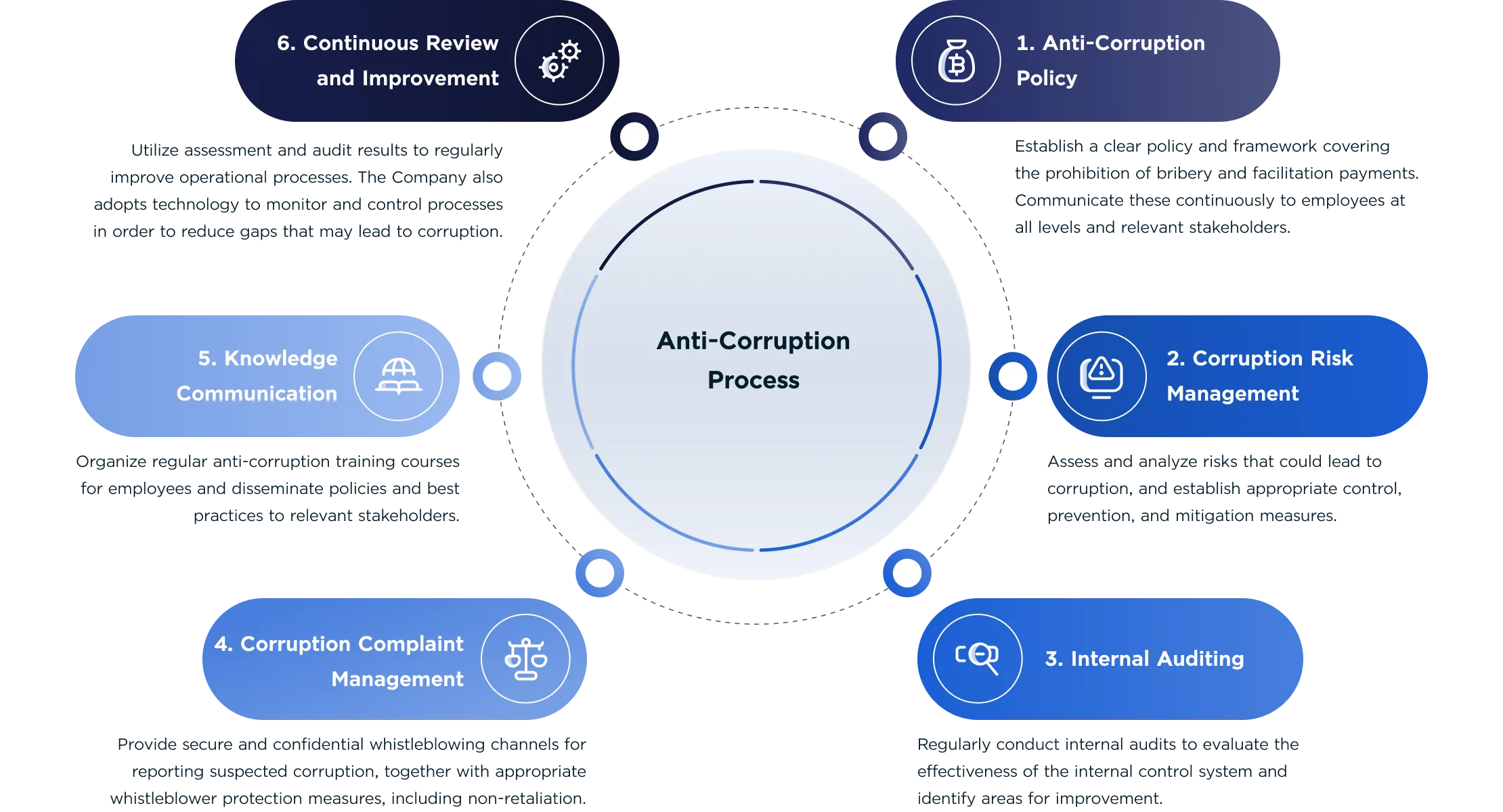
Anti-Corruption Policy
The Board of Directors places the highest priority on anti-corruption oversight and governance. The Company has established an anti-corruption policy and a comprehensive corruption prevention framework across the organization to ensure that the business operations of the Company and its group companies are conducted in accordance with good corporate governance principles, business ethics, transparency, and accountability toward all stakeholders. This approach is aligned with international standards and reflects the Company's commitment under the Thai Private Sector Collective Action Against Corruption (CAC). The Anti-Corruption and Whistleblowing Policy strictly prohibits all forms of corruption, whether direct or indirect. This includes bribery, facilitation payments, conflicts of interest, accounting fraud, improper advantages, inappropriate political contributions, and any conduct that may lead to undue business advantages.
The policy applies to directors, executives, employees, subsidiaries, associates, joint ventures as well as business intermediaries or representatives, consultants, suppliers, business partners, and other stakeholders involved in the Company's business operations. The Board of Directors oversees, supports, monitors, and regularly reviews the effectiveness of relevant policies and measures to ensure they remain adequate and responsive to emerging risks. In 2025, the Company enhanced the policy to ensure more comprehensive and appropriate corruption risk management across all business activities, including both core and supporting operations, as well as the engagement of intermediaries such as contractors and agents. Specific operational guidelines were categorized into clear sections to strengthen internal controls, enhance transparency, and ensure practical and effective implementation across the organization.
Anti-Corruption Guidelines
The provision or acceptance of gifts, hospitality, and related expenses must be transparent, reasonable, and must not influence decision-making or create conflicts of interest. Bribes and facilitation payments in any form are strictly prohibited. Any benefits must be subject to proper approval, and high-value gifts must be reported in accordance with the Company’s regulations.
Charitable donations must be conducted transparently and in compliance with applicable laws, and must not serve as a disguised benefit or a means to facilitate corruption. The purpose of each donation must be clearly defined, subject to an approval process, and verifiable to ensure that funds or resources are used for genuine public benefit.
Sponsorships must be transparent, verifiable, and must not be used as an exchange for undue benefits. Appropriate documentation must be prepared, the purpose of the sponsorship must be clearly specified, and evidence must be available to confirm that the support is used for the intended objectives.
The Company maintains political neutrality and has no policy of providing financial or resource support to political parties, politicians, or election candidates. Employees may exercise their political rights in their personal capacity; however, the Company’s name, assets, or resources must not be used for political activities.
Directors, executives, and employees must avoid using their positions, authority, or confidential information for personal benefit. Transactions that may result in conflicts of interest must be avoided. Individuals are required to disclose any personal relationships or interests that may be related to the Company’s business operations and report any conduct that may violate ethical standards.
Human resource management is conducted fairly, transparently, and with respect for human rights. No benefits may be solicited during the recruitment process. The Company implements preventive measures to mitigate conflict-of-interest risks, including background checks and cooling-off periods for former government officials. Continuous training on ethics and anti-corruption is also promoted.
Accounting and financial operations must be accurate, transparent, and auditable. All receipts and disbursements must be supported by proper documentation and must comply with business objectives and applicable laws. False accounting entries or concealment of financial information are strictly prohibited. Financial reports are prepared in accordance with relevant standards and submitted to regulatory authorities within legally prescribed timeframes.
The Company provides secure and confidential channels for reporting suspected corruption and protects whistleblowers acting in good faith. Investigations are conducted fairly, and disciplinary actions are clearly defined for violations. Internal audit and monitoring are also conducted for high-risk processes such as procurement, sales and marketing, and contracting in order to prevent and reduce corruption risks. Statistical information on complaints and corruption management is disclosed in the Company’s Annual Report to enhance transparency.
The Company continuously communicates its anti-corruption policies and guidelines to employees, business partners, and stakeholders. Training is conducted regularly at least once a year to enhance knowledge, awareness, and accountability at all organizational levels. Policies, measures, and related processes are regularly reviewed and improved to align with evolving risk contexts and to maintain high standards of corporate governance in the long term.
Corruption Risk Management
The Company implements a corruption risk management process in accordance with the framework of CAC. This process is integrated with the Company’s sustainability risk assessment (ESG Risk) to analyze potential corruption risks that may arise from the Company’s operations as well as activities conducted through business intermediaries, such as contractors, agents, consultants, and other representatives acting on behalf of the Company. High-risk operational processes related to corruption are identified and prioritized in order to establish enhanced control measures and appropriate response mechanisms. Corruption risks are categorized into three types: facilitation payments, bribery for illegal acts, and bribery to obtain business opportunities.

Internal Control Measures
- Verifiable Approval Systems: Clear approval authorities with systematic, transparent disbursement processes and complete reference evidence to prevent hidden bribery.
- Targeted Risk Management: Increased frequency of audits for high-risk transactions such as gifts, entertainment, and donations to prevent them from being used as conduits for bribery.
- Third-Party Due Diligence: Comprehensive due diligence conducted before engaging with new partners, suppliers, agents, or contractors, covering ESG Risks, ethical and anti-corruption risks through questionnaires, document reviews and policy checks.

Risk Responses
- Risk Reduction/Treatment: Strengthening internal controls, such as transparent approval and transaction recording systems and enhancing anti-corruption awareness among employees and company representatives.
- Risk Transfer: Incorporating anti-corruption clauses into contracts, utilizing insurance, or engaging external experts when the Company cannot independently control the risks.
- Risk Avoidance: Terminating or avoiding activities, projects, or business relationships with high corruption risks that cannot be mitigated to an acceptable level.
- Risk Acceptance: Accepting risks only within an acceptable level, accompanied by continuous monitoring and review to ensure they do not exceed predefined limits.
Based on the current risk assessment, the Company's corruption risk remains at a low to medium level, with no high-level corruption risks identified. To reinforce confidence in internal controls aligned with the Anti-Corruption Policy, the Internal Audit department has formulated an annual audit plan that specifically examines expense items susceptible to corruption. Furthermore, during every audit engagement, the Internal Audit department incorporates specific audit topics to ensure compliance with the policy across high-risk processes. This ensures that internal control measures remain effective and transparent in managing corruption risks.
Management of Corruption Complaints and Whistleblowing
Whistleblowing and Grievance Channels for Corruption
The Board of Directors has assigned the Audit Committee to independently and fairly receive and consider whistleblowing reports and complaints regarding actions suspected of being direct or indirect corruption. The Company provides whistleblowing and grievance channels for reporting doubts or witnessed misconduct as follows:
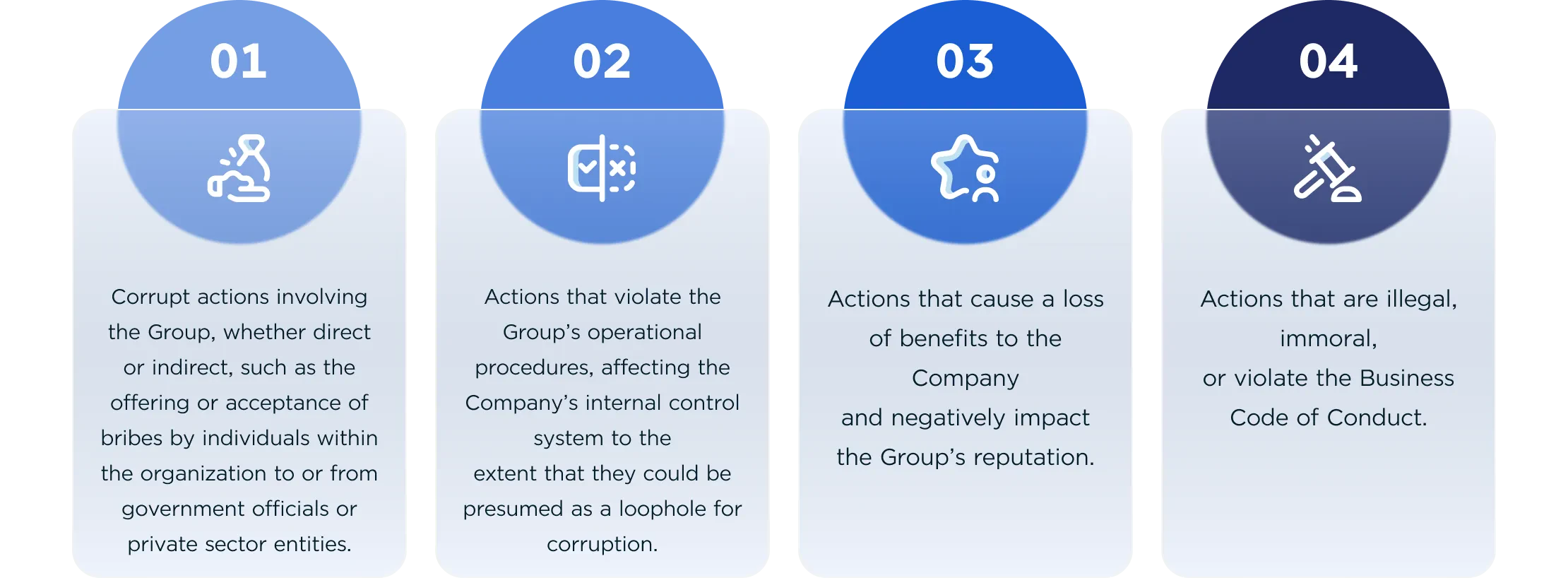
The whistleblower must provide details of the matter or complaint, including:
- Information about the whistleblower (name, position, or department)
- Information about the accused (name, position, or department of the accused or related persons, if known)
- Facts or circumstances of the incident
- Date, time, and location of the incident
- Evidence or supporting documents (if any)
- Contact channel for follow-up (if the whistleblower wishes to be informed of the outcome). Reports can be submitted through any of the following Company channels


Sealed Mail Addressed to the Chairman of the Audit Committee

Corruption Whistleblowing and Complaint Box
The Company accepts and reviews anonymous complaints, provided that the evaluation is based on the completeness of information, facts, and supporting evidence. Anonymity will not be a reason for an automatic rejection of the complaint.
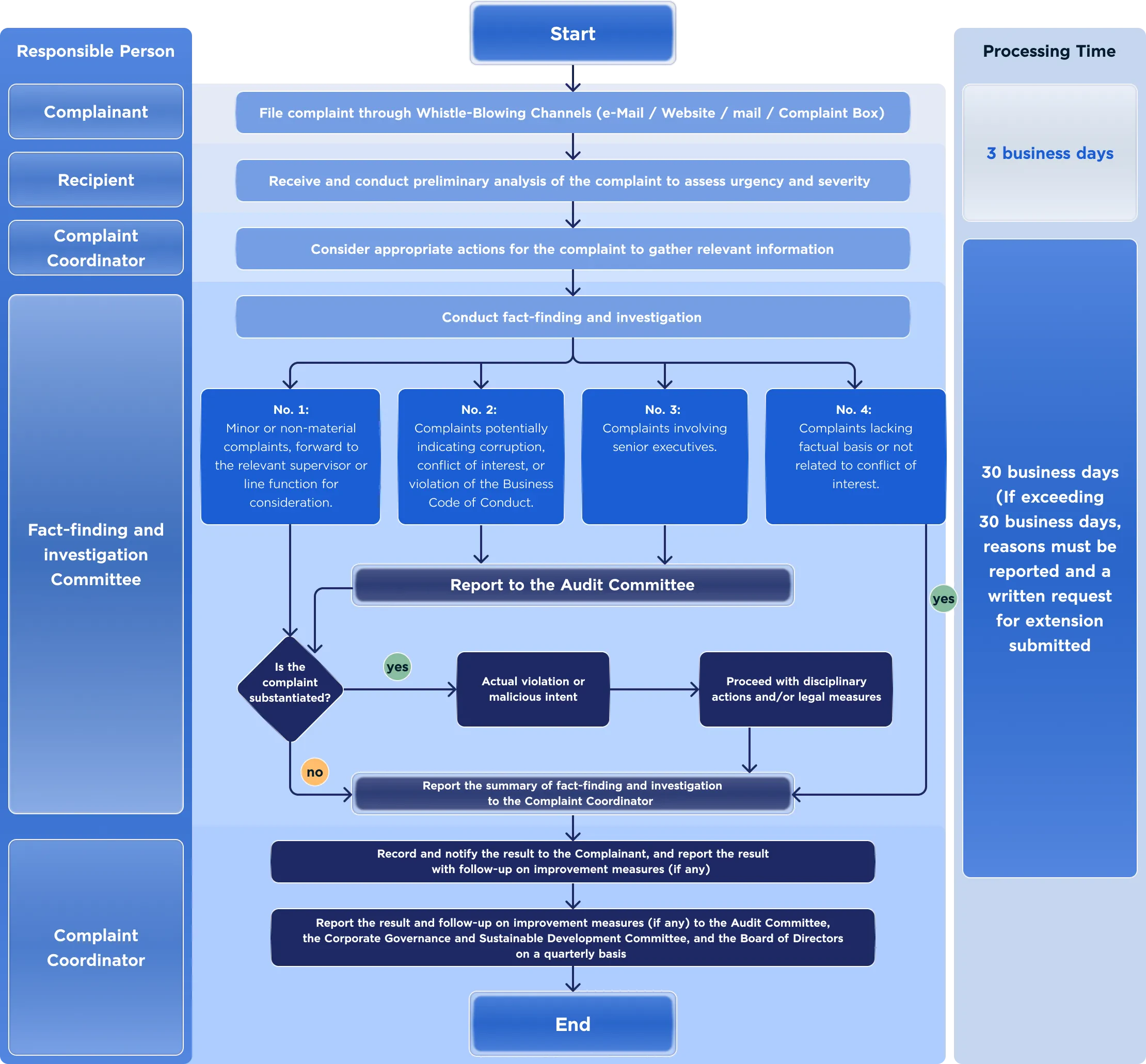
Anti-Corruption Complaint Management Process
The Company has established a process for handling confidential whistleblowing reports and complaints by defining the relevant parties, the complaint-receiving procedures, the investigation process, and disciplinary actions as follows:
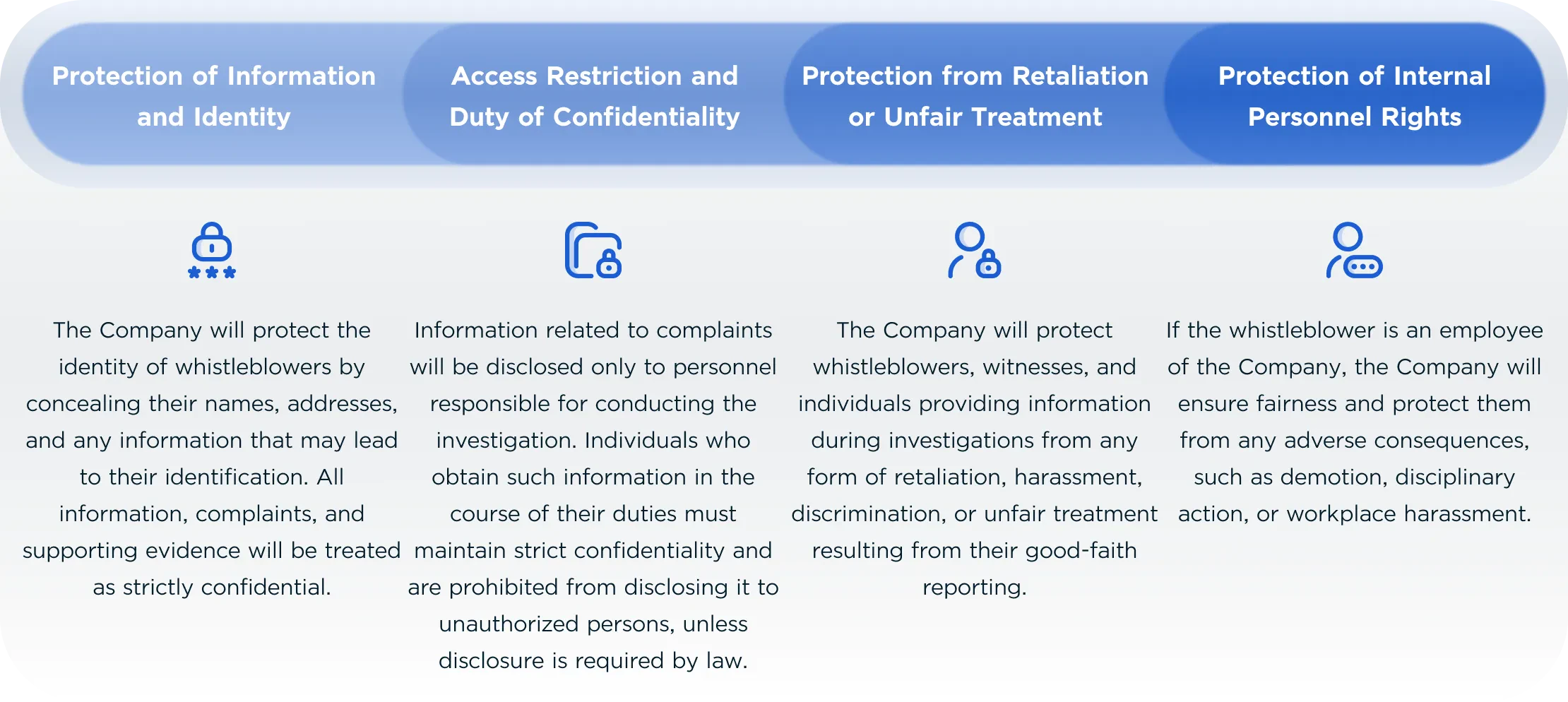
Protection and Confidentiality Measures
To protect the rights of the complainant (whistleblower, informant, or complainant) who acts in good faith, the Company has established strict protection and confidentiality measures as follows:
Communication and Engagement in Anti-Corruption
The Company places strong emphasis on continuous communication and the cultivation of an organizational culture that promotes anti-corruption practices. These efforts aim to enhance knowledge, understanding, and ethical awareness among employees at all levels as well as relevant stakeholders. Anti-corruption training has been incorporated as an integral component of the Company's human capital development process. In 2025, the Company enhanced the training program titled "Roles of Executives and Employees in Anti-Corruption" by transitioning it into an e-learning format on the Gunkul Learning Management System (LMS). This allows employees to access learning opportunities more broadly and continuously. The course is mandatory for all new employees, while existing employees may voluntarily access the course at any time for knowledge refreshment. As a result, 100% of new employees completed the training program. The curriculum comprehensively covers key anti-corruption topics, including:
- Definition, forms, and elements of corruption, including all forms of bribery.
- Potential corruption risk situations in business operations.
- Business Code of Conduct and the Anti-Corruption Policy.
- Roles and responsibilities of directors, executives, and employees in preventing and monitoring corruption.
- Fostering an ethics-driven corporate culture and demonstrating moral leadership (Tone from the Top).
- Decision-making guidelines when facing an Ethical Dilemma.
- Prevention of conflicts of interest and the misuse of insider information.
- Whistleblowing channels and whistleblower protection.
These initiatives enable employees at all levels to gain a correct understanding of the Company's anti-corruption policy, apply the principles in their daily work, and appropriately communicate key messages to relevant stakeholders. This contributes to strengthening the Company's corruption prevention system, making it more robust and sustainable.
In addition, the Company continuously communicates its anti-corruption policy and whistleblowing or grievance channels to business partners through the "Supplier Code of Conduct," which is designated as a key document in the Vendor Registration process. Suppliers are required to acknowledge, understand, and sign their acceptance of these principles to confirm their understanding and commitment to complying with the Company's ethical standards before conducting business together. This reflects the creation of shared awareness and accountability throughout the supply chain.
Stakeholders Directly Impacted

Employees

Suppliers

Customers

Competitors

Shareholders and Investors

Public Sector

Business Partners

Communities and Society

Our Projects