
Human Rights and Fair Labor Practices

Supporting the SDGs


Goals and Performance Highlights

2025 Target
2025 Performance
Challenge and Opportunity
To support sustainable business growth, the Company not only focuses on improving operational efficiency but also recognizes the importance of respecting and protecting human rights in line with internationally recognized principles.
This commitment extends across the entire value chain, covering all stakeholder groups, including employees, business partners, customers, communities, and society, based on the principles of equality, fairness, and respect for diversity. The Company believes that effective management of labour standards and human rights is closely linked to corporate credibility, investor confidence, and the ability to conduct business with both domestic and international partners. At the same time, the Company acknowledges that operational activities and supply chain operations may face challenges related to labour rights and potential impacts on communities. Without appropriate oversight, such challenges could lead to grievances, conflicts, or disruptions to project continuity. Therefore, the Company integrates human rights considerations into its operational processes and enterprise risk management framework. This approach helps mitigate risks, prevent human rights violations, and ensure compliance with applicable laws and standards, while enabling the Company, communities, and society to grow together in a stable and sustainable manner.

Management Approach and Value Creation
Human Rights Due Diligence Process
The Company conducts a comprehensive Human Rights Due Diligence (HRDD) process to identify, assess, and implement measures to prevent and mitigate human rights risks and impacts. This process covers the operations of the Company and its subsidiaries, as well as stakeholders across the business value chain, including employees, suppliers, business partners, communities, society, and potentially affected vulnerable groups.
The Company places importance on engaging with relevant stakeholders and listening to their perspectives to ensure that its business operations do not cause or contribute to human rights violations. The Company’s human rights due diligence framework consists of the following key steps:
- Establishment of Human Rights Policy The Company has established a Human Rights Policy to demonstrate its commitment to respecting internationally recognized human rights principles. The policy is communicated to employees, business partners, and relevant stakeholders to promote shared understanding and expectations for responsible business conduct.
- Risks and Impacts Assessment The Company regularly conducts human rights risk and impact assessments covering both its operational activities and supply chain operations. The assessment considers both actual and potential human rights impacts, enabling the Company to identify material issues and prioritize appropriate management actions.
- Integration and Management The results of the risk assessment are integrated into the Company’s management processes, including procurement procedures, supplier selection and evaluation, human resource management, and project operations. Preventive and mitigation measures are implemented accordingly, supported by training and internal communication to enhance awareness among employees and relevant stakeholders.
- Monitoring and Reporting The Company monitors and evaluates the effectiveness of its human rights measures through internal audit processes and regular reporting to management. This ensures that the implemented measures effectively mitigate human rights risks and impacts. Relevant information is disclosed through the Company’s Sustainability Report to promote transparency.
- Grievance Mechanism and Impact Remediation The Company provides accessible grievance mechanisms for both internal and external stakeholders to raise concerns related to human rights issues. Complaints are handled through a process that is impartial, transparent, and confidential. Where human rights impacts are identified, the Company undertakes appropriate corrective and remedial actions, while strengthening preventive measures to avoid recurrence.


Human Rights Policy
The Company conducts its business with a strong commitment to respecting and protecting the human rights of all stakeholders, recognizing this as a fundamental foundation for sustainable growth. The Company’s Human Rights Policy has been developed in alignment with internationally recognized principles, including the Universal Declaration of Human Rights (UDHR), the United Nations Guiding Principles on Business and Human Rights (UNGPs), the International Labour Organization (ILO) Declaration on Fundamental Principles and Rights at Work, the OECD Guidelines for Multinational Enterprises, as well as labour and human rights laws in the countries where the Company operates.
This policy applies to the Board of Directors, management, employees at all levels, business partners, joint venture partners, suppliers, and stakeholders across the value chain. The policy is regularly communicated and promoted to ensure shared understanding and responsible business conduct, and is reviewed at least annually to ensure alignment with evolving business contexts, legal requirements, and stakeholder expectations. To put its human rights commitments into practice, the Company has established the following key guidelines:
Non-discrimination, Promotion of equality, diversity, equity and respect for differing opinions:
The Company treats all stakeholders fairly and with respect for human dignity and strictly prohibits discrimination based on gender, age, race, nationality, religion, language, disability, social status, sexual orientation, culture, customs, or any other differences. The Company promotes diversity, equity, inclusion, and mutual respect in the workplace.
Prohibition of Illegal Labor
The Company complies with applicable laws and does not support or engage in any form of illegal labour, including forced labour, child labour, modern slavery, human trafficking, or employment practices that violate labour laws. The Company also expects its business partners to prevent such violations across the value chain.
Fair Employment and Labor Practices
The Company ensures that recruitment, employment, compensation, employee benefits, working hours, and employee development are conducted fairly, transparently, and in compliance with labour laws, while supporting employees’ well-being, quality of life, and work–life balance.
Occupational Health, Safety, and Working Environment
The Company provides a safe and healthy working environment with appropriate occupational health and safety management systems to prevent workplace accidents and health impacts on employees, contractors, and related parties, while continuously promoting a strong safety culture.
Freedom of Association and Collective Bargaining
The Company respects employees’ rights to freedom of association and collective bargaining, allowing them to form associations or appoint representatives to negotiate employment conditions without intimidation, discrimination, or retaliation, in accordance with applicable laws.
Respect for Community and Social Rights
The Company conducts its operations with consideration for the potential impacts on communities, the environment, public health, and local livelihoods in areas where it operates. The Company engages with communities through appropriate consultation processes and contributes to sustainable community development.
Human Rights Responsibility in the Supply Chain
The Company communicates its human rights expectations to suppliers, contractors, and business partners while conducting risk assessments and monitoring compliance to prevent and mitigate human rights risks across the value chain.
Personal Data Protection and Privacy
The Company respects the privacy rights of all stakeholders and implements appropriate measures for the collection, use, disclosure, and protection of personal data in accordance with applicable laws and regulations.
Communication, Awareness-Raising, and Training
The Company regularly communicates its Human Rights Policy and related guidelines to employees, suppliers, and stakeholders, while organizing training and awareness programs to promote responsible conduct and respect for human rights.
Grievance Mechanisms, Protection, and Remediation
The Company provides accessible, secure, and confidential grievance channels for individuals who are affected by or witness human rights violations. Complaints are handled through a fair and transparent process with whistleblower protection and appropriate corrective and remedial actions.
Monitoring and Continuous Improvement
The Company implements a Human Rights Due Diligence (HRDD) process to regularly monitor, assess, and improve its human rights management practices. Policies and procedures are periodically reviewed to ensure alignment with evolving business conditions and legal requirements.
To ensure transparent business operations that create sustainable value for stakeholders, the Company has established a clear human rights responsibility and governance structure:
- Board of Directors Delegates human rights oversight to various levels. The Good Corporate Governance and Sustainable Development Committee oversees human rights operations, sets policy directions, monitors performance and critical stakeholder issues, and provides recommendations for continuous improvement. The Risk Management Committee oversees sustainability-related risks, including human rights risks, integrating these considerations into the Enterprise Risk Management (ERM) framework. The Audit Committee verifies the adequacy of internal controls and compliance with relevant policies and procedures.
- Senior Management Drives policy implementation by integrating human rights considerations into business strategies, risk management, and operational decision-making. Management also allocates the necessary resources, including personnel, budget, and capacity building, to ensure effective and continuous human rights management.
- Operational Level The Company has established a Human Rights and Diversity, Equity and Inclusion (DEI) Working Group, comprising representatives from relevant departments such as Human Resources, Sustainability, Legal, and Procurement, to support the implementation of human rights due diligence processes. The working group oversees human rights risk assessments, impact prevention, monitoring, and systematic reporting.
Human Rights Risk Assessment
The Company integrates human rights risks into the Enterprise Risk Management (ERM) framework under the social dimension of ESG risk management. These risks are considered alongside strategic, operational, financial, and compliance risks to support responsible business conduct and sustainable growth.
As part of its Human Rights Due Diligence (HRDD) process, the Company conducts Human Rights Risk Assessments for both potential future projects and ongoing operations. The assessment aims to identify and prioritize salient human rights issues relevant to the Company’s business activities across three core business groups: energy business, high-voltage electrical equipment business, and engineering and turnkey businesses, including activities across the value chain. The assessment follows the Company’s enterprise risk assessment methodology, evaluating both the likelihood of occurrence and the severity of impacts to prioritize risks and implement appropriate mitigation measures. The Company also considers stakeholder expectations gathered through indirect engagement channels, such as satisfaction surveys, public consultation forums, and relevant secondary information, to support comprehensive risk identification.
| Employee Rights | Business Partner / Contractor Rights | Customer Rights | Community Rights |
|---|---|---|---|
|
1.1 Working conditions (excessive working hours) 1.2 Health and safety 1.3 Employment of illegal labor (child labor, forced labor and human trafficking in all forms) 1.4 Discrimination 1.5 Freedom of association and collective bargaining 1.6 Workplace harassment and violence 1.7 Fair wages and benefits |
2.1 Working conditions (excessive working hours) 2.2 Health and safety 2.3 Employment of illegal labor (child labor, forced labor and human trafficking in all forms) 2.4 Discrimination 2.5 Fair wages and benefits |
3.1 Health and safety 3.2 Discrimination 3.3 Personal data violations |
4.1 Health and safety 4.2 Standard of living 4.3 Land rights and forced resettlement 4.4 Right to participation and access to information |
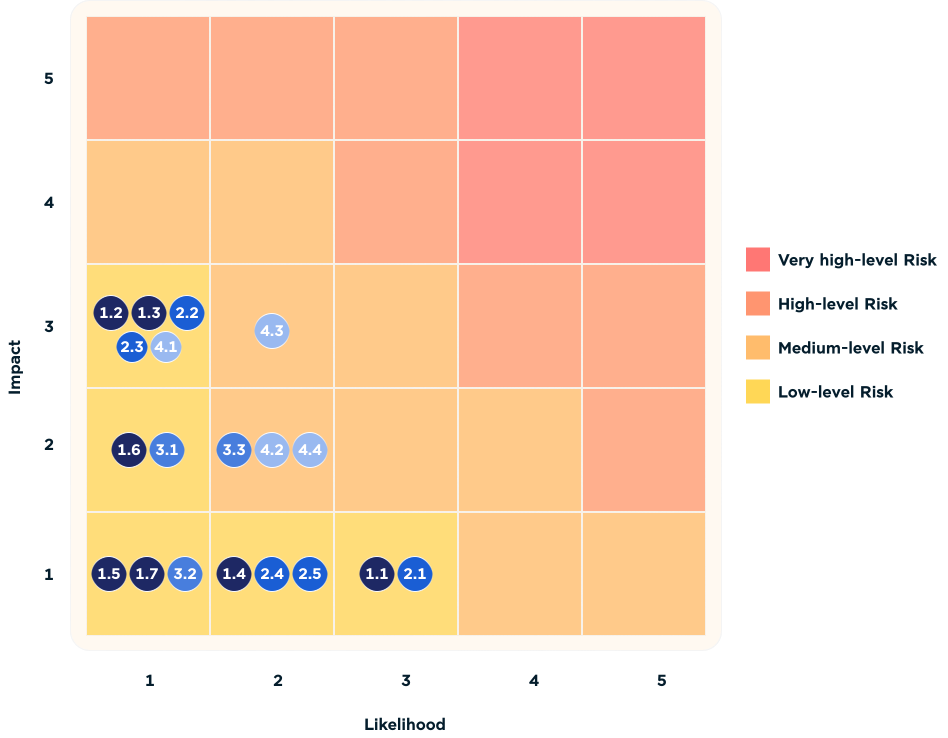
Based on the 2025 Human Rights Risk Assessment, as depicted in the Risk Matrix above, the majority of issues were identified at a Low risk level. These encompass: working conditions (1.1), health and safety (1.2), employment of illegal labor (1.3), discrimination (1.4), freedom of association and collective bargaining (1.5), workplace harassment and violence (1.6) and fair wages and benefits (1.7) for employees; working conditions (2.1), health and safety (2.2), employment of illegal labor (2.3), discrimination (2.4), and fair wages and benefits (2.5) for business partners/contractors; health and safety (3.1) and discrimination (3.2) for customers; and health and safety (4.1) for communities. Meanwhile, issues identified at a Moderate risk level include: customer personal data violations (3.3), community Standard of living (4.2), the Land rights and forced resettlement (4.3) and the community’s right to participation and access to information (4.4).
Significantly, the Company identified no human rights risk issues at a High or Very High level. These assessment results are subsequently utilized to establish preventive and mitigation measures, with continuous monitoring under the Enterprise Risk Management (ERM) system, to reinforce sustainable business operations and respect for human rights in all dimensions.
Integration and Management
As no High or Very High human rights risks were identified, the Company integrated the Medium-level risk assessment results to establish internal management controls. This aims to reduce the likelihood and severity of potential impacts on stakeholders in the value chain, as follows:
| Human Rights Risk Issue | Stakeholders | Preventive and Risk Control Measures |
|---|---|---|
| Customer personal data violations (3.3) |

Customers |
Establish personal data protection policies aligned with relevant laws. Control data access rights, utilize robust cybersecurity systems (Firewall, 2FA, DRP) and regularly train employees on confidentiality. |
| Community Standard of living (4.2) |

Communities and Society |
Promote local employment and continuously support community development and CSR activities to generate positive economic impacts and elevate the quality of life for local residents. |
| Land rights and forced resettlement (4.3) |
Communities and Society |
Verify land rights documents, conduct land leasing or utilization transparently and proactively communicate with communities prior to project development. |
| Right to participation and access to information (4.4) |
Communities and Society |
Organize public hearings, communicate project information transparently, and provide accessible channels for community feedback and grievances. |
Furthermore, the Company places strong emphasis on fair labour practices, which serve as a key mechanism for preventing human rights risks within the organization. The principle of respect for human dignity is therefore integrated into the Company’s human resource management practices. The Company promotes Diversity, Equity, and Inclusion (DEI) to foster an open, fair, and non-discriminatory working environment. DEI initiatives not only help mitigate the risks of discrimination and unfair labour practices but also serve as an important foundation for strengthening employee engagement and supporting the Company’s sustainable growth. Accordingly, the Company discloses information on workforce structure and employee composition in the following section to reflect the diversity of its workforce across various dimensions, demonstrating the practical outcomes of integrating these principles into its human resource management practices.
Workforce Diversity Data

Employees by Job Level
Employees by Generation
Employees by Employment Type
Employees by Nationality


Employees with disabilities

Elderly Employees
The Company operates under strategies and guidelines for fair labor practices and comprehensive personnel development to create a work environment conducive to the happiness, equality, and inclusion of all employees. Adhering strictly to human rights principles, labor protection laws and relevant international labor standards, the Company respects and supports employees' freedom of association and the right to collective bargaining, providing opportunities for appropriate participation and communication with management. The Company treats all employees equally, strictly prohibiting discrimination based on race, religion, gender identity, age, sexual orientation, disability, or nationality across recruitment, hiring, and career development processes. Furthermore, the Company appropriately manages working hours and overtime to mitigate the risks of excessive working hours. It provides fair wages, compensation, and benefits that are sufficient for a decent standard of living (living wage), which are higher than the legally mandated minimum wage. Through these efforts, the Company actively promotes Diversity, Equity, and Inclusion (DEI) to ensure all employees can work together efficiently and grow sustainably alongside the organization.
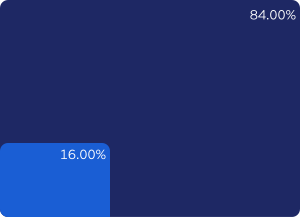
As of December 31, 2025, the Company had a total of 1,217 employees, comprising 59% male and 41% female, reflecting gender diversity within the organization. The majority of the workforce is in the core working age group, consisting of Generation Y (50.53%), Generation Z (28.10%), Generation X (20.62%), and Baby Boomers (0.74%). Regarding the employment structure, 84% are full-time employees and 16% are contract employees. The job level structure spans the operational level, junior to mid-level, department/unit head level, managerial level, and executive level, reflecting opportunities for career growth and development within the organization. The majority of employees are Thai nationals (96.30%), alongside other nationalities (3.70%). Furthermore, the Company prioritizes equal career opportunities by employing vulnerable groups, including 8 employees with disabilities and 12 elderly employees, to support the inclusive participation of all societal sectors and sustainably elevate the quality of life for its personnel.
Promoting Diversity, Equity, and Inclusion (DEI)
In addition, the Company has implemented a leave policy that promotes Diversity, Equity, and Inclusion (DEI), ensuring all employees can exercise their leave rights equally without discrimination based on gender, religion, belief, or personal status. The Company respects the diverse identities and lifestyles of its employees by granting Marriage Leave regardless of the spouse's gender, encompassing male-female, male-male, and female-female marriages, whether registered domestically or internationally.
Respecting religious freedom, the Company allows employees of all faiths to utilize leave for ordination or other religious ceremonies, such as the Hajj, as well as leave for religious rites following the loss of a family member, in accordance with established criteria. Moreover, the Company provides Gender Reassignment Leave for employees of all genders under appropriate and fair criteria that respect human dignity.
In the area of social engagement, the Company has incorporated Volunteer Leave as part of its Business Leave policy. Employees may utilize this leave to participate in volunteer, community, or charitable activities without affecting their regular employment rights. This mechanism reflects the Company’s commitment to encouraging employees to actively engage with charitable organizations and social initiatives. The establishment of Volunteer Leave provides a clear structure and support mechanism for employee volunteering. The initiative aligns with the Company’s objective of creating shared value (CSV) and fostering an organizational culture that promotes social responsibility, while ensuring employees are treated fairly and equitably.
Communication and Human Rights Awareness
The Company consistently prioritizes communicating and cultivating a human rights corporate culture to build knowledge, understanding, and awareness among employees at all levels regarding human rights respect and responsible, sustainable business conduct. The Company integrates the Human Rights Policy and labor standard compliance into its personnel development process. It is mandated as part of the New Employee Onboarding Program under the ESG and sustainable business goals topic. This ensures that new employees possess knowledge and understanding of the Company's human rights guidelines, their roles and responsibilities, and the prevention of human rights violations throughout the value chain. Consequently, 100% of new employees successfully completed this training and fully acknowledged the human rights policies and guidelines. Furthermore, the Company developed an e-Learning course titled "Human Rights and Business Operations" on the Gunkul LMS system to promote comprehensive and continuous access for all employees to learn and review human rights knowledge. The course content covers key issues regarding human rights respect, human rights risk management, and the prevention of complicity in human rights violations involving business partners and stakeholders. In addition, the Human Rights Policy and guidelines are regularly communicated and disseminated through internal channels, including the intranet, the Nascenter system, internal emails, and office public relations media. They are also communicated to all external stakeholder groups via the Company’s website to foster understanding and tangible implementation throughout the organization.
Beyond communicating and providing human rights policy training to employees, the Company systematically manages and addresses labor issues. This is to prevent internal labor rights violations, as well as complicity in child labor and forced labor within both the Company's activities and the supply chain. Moreover, the Company established the Labor Welfare Committee as a mechanism for employee representatives to participate with management in overseeing and developing labor operations. The committee's duties include providing recommendations, verifying compliance with labor laws and standards, overseeing welfare and the cost of living, and ensuring working hours are appropriately managed within legal limits. It also serves as a channel for fair communication and collective bargaining.
Alongside these efforts, the Company continuously communicates its human rights and labor policies to business partners through the "Supplier Code of Conduct," which is mandated as a critical document in the vendor registration process. Suppliers must acknowledge, understand, and sign their acceptance of these principles prior to commencing business operations together. These principles cover key issues such as the non-use of child labor, the non-use of forced labor, respect for freedom of association, appropriate working hour management, and the payment of fair wages and benefits sufficient for a decent living. The Company retains records of the suppliers' acknowledgment and acceptance of the Code of Conduct as evidence within the vendor registration system. This data is utilized as part of the continuous oversight and monitoring of suppliers' compliance with human rights and labor standards. It is also used to evaluate suitability in selecting and maintaining business relationships, thereby promoting awareness, shared responsibility, and compliance with appropriate labor standards throughout the supply chain.
Monitoring and Reporting
The Company regularly monitors, reviews, and evaluates the effectiveness of human rights risk management measures by integrating them into the Enterprise Risk Management (ERM) framework and sustainability management processes. At the operational level, relevant departments together with the Human Rights Working Group monitor performance indicators, track related grievances, and report progress periodically to responsible management.
Key performance results and significant risk issues are then reported through the governance structure to the Risk Management Committee, which oversees human rights risks under the ESG risk management framework, and the Corporate Governance and Sustainable Development Committee, which reviews performance and provides policy recommendations before reporting to the Board of Directors. To ensure transparency and accountability, the Company discloses its human rights performance to stakeholders annually through the Sustainability Report, the 56-1 One Report, and the Company’s website.
Grievance Mechanism and Impact Remediation
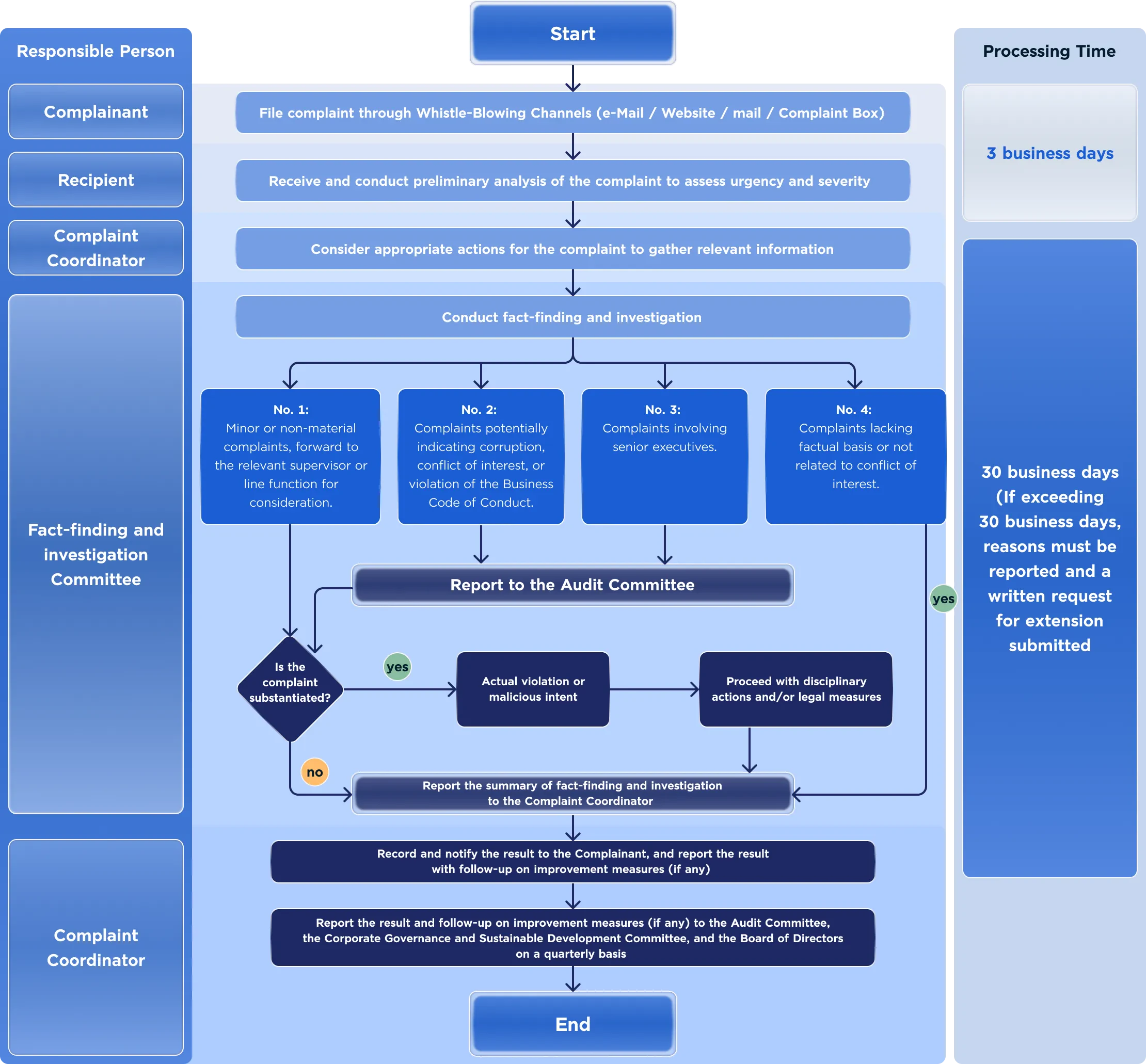
The Company has established a systematic, transparent and fair grievance mechanism to handle issues of misconduct, human rights violations, discrimination, workplace bullying or harassment and actions violating laws, policies, or the Business Code of Conduct. The Company provides a secure platform for personnel, stakeholders and external parties to report information based on good faith, impartiality, non-discrimination, and confidentiality. It strictly protects whistleblowers, witnesses, and informants from retaliation or unfair treatment.
Grievance Channels
Complainants can report whistleblowing concerns or grievances through multiple channels operating under the independent and fair oversight of the Audit Committee. These include: The Audit Committee’s email: audit_committee@gunkul.com The Company’s website: https://www.gunkul.com/en/governance/whistleblowing-channel Sealed letter directed to the Chairman of the Audit Committee: Gunkul Engineering Public Company Limited, 548 One City Centre (OCC), 44th Floor, Phloen Chit Road, Lumphini, Pathum Wan, Bangkok 10330 “Whistle Blowing and Complaints Box” Internal grievance boxes. The receiving unit (Internal Audit Department, under the Audit Committee's supervision) is responsible for receiving, registering, and conducting initial screenings. The Company also accepts anonymous grievances, evaluated based on the completeness of the provided information and supporting evidence.
Whistleblowing and Complaint ChannelProtection and Confidentiality Measures
The Company keeps the information, identities and related documents of the complainant and involved parties strictly confidential, restricting access solely to authorized investigation personnel. Furthermore, the Company strictly prohibits any form of bullying, intimidation, demotion, or retaliation, enforcing a strict Non-retaliation principle. At the same time, the accused party retains the right to clarify the matter and receive fair treatment based on the principle of impartiality.
Grievance Handling, Remediation, and Penalties
If an investigation confirms misconduct, the Company will take disciplinary and legal actions and establish preventive measures to avoid recurrence. In cases involving human rights violations or harassment, the Company will determine appropriate remediation measures aligned with international human rights principles, prioritizing human dignity and the voluntary consent of the affected individuals. These may include formal apologies, compensation for damages, restoration of rights, improvement of working conditions, or the cessation of the impactful behavior. However, if a complaint is found to be intentionally fabricated, the Company may act in accordance with its regulations and the law. The Company will appropriately notify the complainant of the resolution outcome while maintaining confidentiality. The information will be recorded in the grievance registry, and a summary report will be submitted to the Audit Committee and the Board of Directors, alongside tracking corrective and improvement measures to prevent recurrence.
These mechanisms are an integral part of good corporate governance, helping to mitigate corruption and human rights risks while strengthening stakeholder confidence. They also support a safe working environment that respects human dignity and ensures fairness for everyone in the organization.
Stakeholders Directly Impacted

Employees

Suppliers

Customers

Competitors

Shareholders and Investors

Public Sector

Business Partners

Communities and Society