

Climate Actions
Supporting the SDGs


Goals and Performance Highlights

2025 Target
2025 Performance

2025 Target
2025 Performance
Challenge and Opportunity
Climate change represents a strategic factor that influences the Company’s long-term business direction. The energy and infrastructure sectors are inherently exposed to both physical risks, such as extreme weather events and climate variability, and transition risks, including evolving climate policies, regulatory requirements, and measures aimed at reducing greenhouse gas (GHG) emissions.
These factors may affect project development costs, engineering and construction standards, investment returns, and overall business competitiveness. If not effectively managed, such risks could potentially disrupt operational continuity and limit the Company’s long-term growth prospects. At the same time, the global transition toward a low-carbon economy and clean energy systems presents significant opportunities for the Company to expand its business portfolio. The Company actively invests in renewable energy projects and green energy infrastructure to support the energy transition and address the increasing demand for sustainable and low-carbon energy solutions. This strategic direction is aligned with Thailand’s national climate ambition to achieve Net Zero Greenhouse Gas Emissions by 2050. The Company therefore integrates climate risk management with adaptive and forward-looking business strategies to strengthen operational resilience while creating long-term environmental and social value.
Management Approach and Value Creation
Climate-Related Risk and Opportunity Management
The Company recognizes that climate change is a significant external factor that may affect its long-term business operations, including operational continuity, electricity generation efficiency, operating costs, and evolving market demand for energy.
To address these potential impacts, the Company has developed an approach to climate-related management and disclosure by referencing internationally recognized frameworks, including the recommendations of the Task Force on Climate-related Financial Disclosures (TCFD) and the IFRS S2 Climate-related Disclosures Standard, in order to enhance preparedness for future disclosure requirements. Although the Company has not yet fully adopted these frameworks in a standalone reporting format, climate-related considerations have already been integrated into the Company’s Enterprise Risk Management (ERM) process in accordance with the COSO-ERM framework. Climate-related risks are systematically identified, analyzed, and assessed across all operational areas, including power generation projects, construction activities, and office buildings, both domestically and internationally. The Company has also established risk mitigation measures and monitoring mechanisms, which are linked with the Business Continuity Plan (BCP) to ensure preparedness for potential disruptions that may affect business operations.
In conducting the assessment, the Company classifies climate-related risks into two main categories: Physical Risks and Transition Risks. These risks are evaluated across short-, medium-, and long-term time horizons. The results of these assessments are incorporated into project planning, engineering design, operational management, and investment decision-making processes. Climate-related considerations are also incorporated into capital allocation decisions, particularly for renewable energy projects, climate-resilient infrastructure, and internal energy efficiency initiatives. In addition, climate-related risks are considered in the management of Operating Expenditure (OPEX) associated with risk mitigation measures, including disaster-resilient structural design, preventive maintenance activities, and the preparation and verification of greenhouse gas (GHG) emissions inventories. These measures help maintain business stability and strengthen the Company’s long-term competitiveness.
Climate Scenario Analysis
The Company incorporates climate-related data and weather variability trends into its risk assessment and project planning processes. Factors considered for their potential impact on operational performance and long-term investments include rising temperature trends, the frequency and severity of storms, rainfall patterns, and the variability of renewable energy resources. Historical climate statistics and location-specific data are applied in project design and development. For example, historical flood data are used to determine the elevation levels for solar photovoltaic (PV) installation structures, while long-term wind speed analysis is conducted prior to investment in wind power projects. In addition, weather forecasting data are utilized to support construction planning and operational management. These analyses support project site selection, engineering design, and long-term investment planning, thereby enhancing the resilience of infrastructure and improving preparedness for future climate variability. The Company also plans to further strengthen and expand its climate scenario analysis processes in the future.
Climate-Related Risks, Impacts, and Mitigation Measures
| Risk Issues | Impacts | Response and Adaptation Measures |
|---|---|---|
| Physical Risk | ||
| Extreme Weather Events and Natural Disasters (Floods, Storms, Strong Winds, Snow, and Earthquakes) | Physical damage to solar PV modules, wind turbines, and electrical infrastructure; temporary operational shutdowns; increased repair and maintenance costs; and potential impacts on electricity sales revenue. |
|
| Climatic Volatility affecting Power Generation Efficiency (Solar Irradiance, Wind Speed, and Temperature) | Power generation output falling below projections, adversely affecting revenue streams and the long-term investment viability of projects. |
|
| Construction Project Risks | Project timeline slippage, increased construction costs, and financial exposure to contractual penalties and liquidated damages. |
|
| Supply Chain and Logistics Impacts | Logistics and raw material delays, delays in contractual delivery obligations, risk of financial penalties, and affecting customer relationships. |
|
| Transition Risk | ||
| Climate Laws, Standards, and Regulations (Disclosure Requirements, Carbon Tax, and Emissions Trading Systems (ETS)) | Increased reporting obligations and operational costs, potentially impacting project investment returns. |
|
| Competition and Energy Industry Structural Shifts | Reduced market competitiveness due to a lack of adaptation. |
|
| Rising Consumer Demand for Clean Energy | Requirement to reconfigure product portfolios and service delivery models. |
|
| Corporate Greenhouse Gas (GHG) Management | Heightened pressure from regulators, investors, and partners for GHG reductions, leading to increased CAPEX and OPEX and potential risks to capital access or business opportunities if management is inadequate. |
|
Based on the assessment of climate-related risks and opportunities, the Company recognizes that these issues are directly linked to its business operations, investments, and long-term competitiveness. These include physical risks that may affect operational continuity and transition risks related to evolving policies, regulations, and stakeholder expectations. The Company has therefore established operational approaches to address these impacts across two dimensions: 1) Climate Change Mitigation and Adaptation Management and 2) Corporate Greenhouse Gas (GHG) Management. The details are as follows.
Climate Change Mitigation and Adaptation Management
As an integrated renewable energy provider, the Company recognizes the private sector's vital role in addressing climate change. We are committed to the continuous development and integration of clean energy technologies and innovations to reduce greenhouse gas emissions within the energy sector and facilitate the transition to a low-carbon society.
Our operations are guided by the strategic framework "Create, Contribute, and Share.” The Company focuses on developing clean energy projects and energy infrastructure to increase the share of renewables in the energy mix, enhance clean energy accessibility for both industrial and social sectors, and generate environmental value alongside long-term business growth. These initiatives serve as a strategic response to energy transition risks and the rising global demand for clean energy.
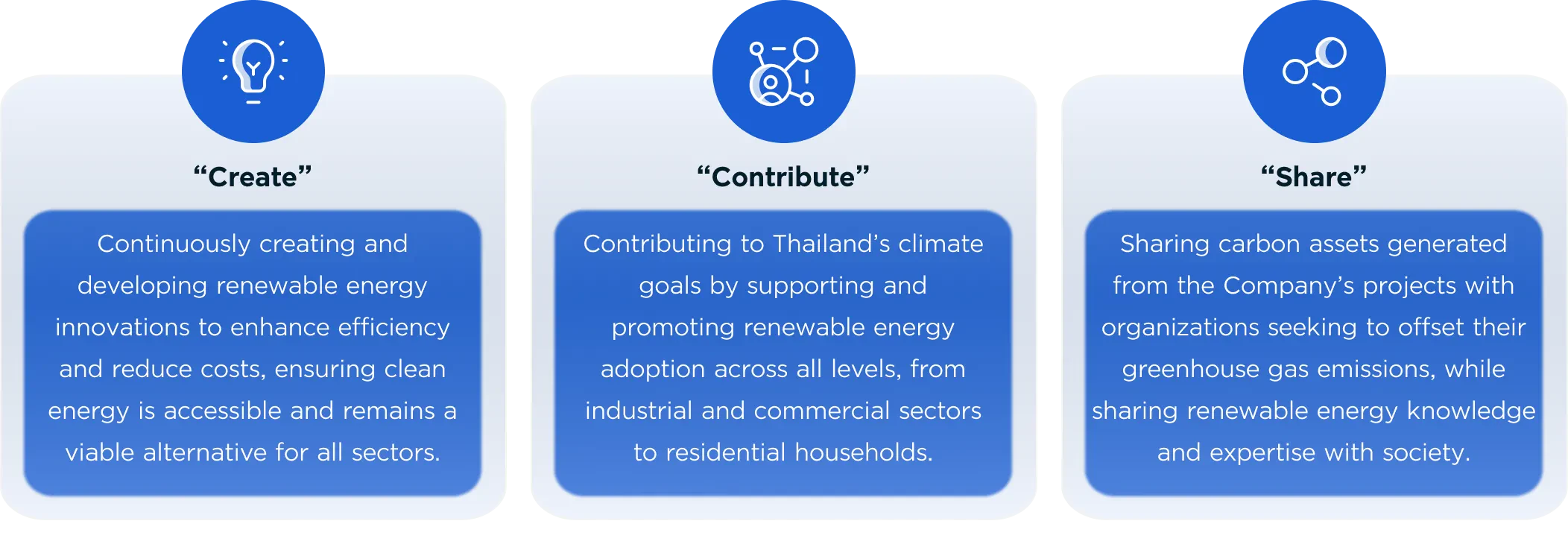
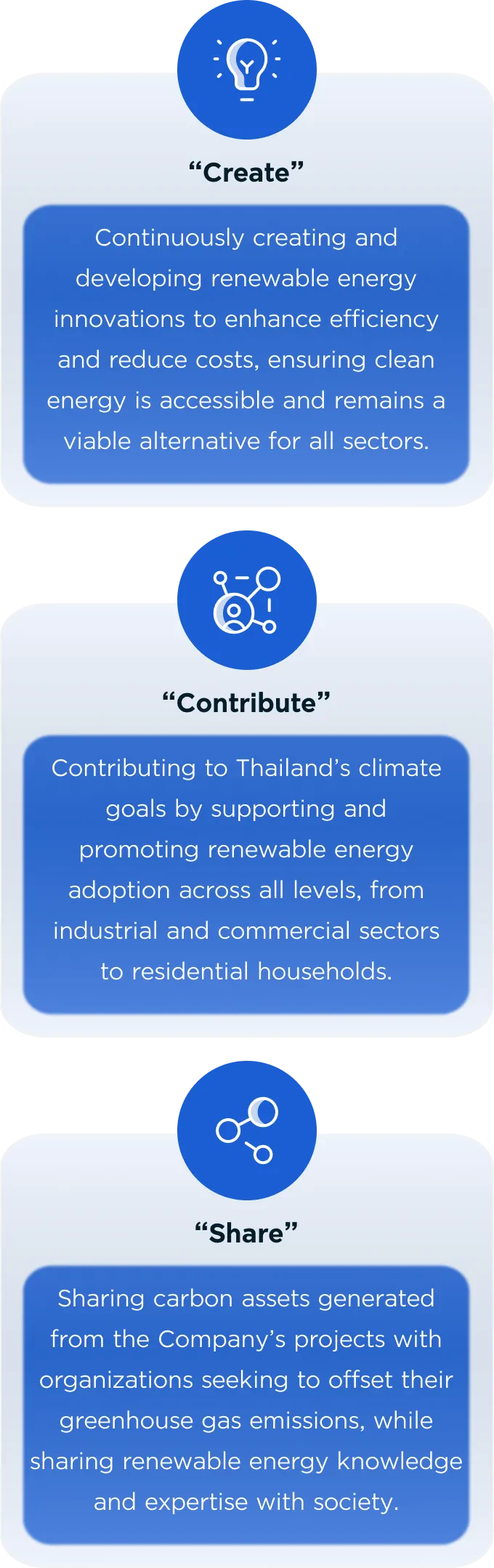
Strategic Management through the "Create, Contribute, and Share" Framework Aligned with National Climate Targets


“Create” The Company plays a pivotal role at the national level by operating renewable energy plants and developing energy innovations that significantly and sustainably reduce greenhouse gas emissions. Key projects and activities include the following items.
- Jointly developing wind and solar power projects integrated with Battery Energy Storage Systems (BESS) under the 2022 to 2030 Feed-in Tariff (FiT) scheme for non-fuel cost renewables, which aligns with the Thailand Power Development Plan (PDP).
- Expanding solar rooftop businesses as Distributed Generation (DG) sources based on decentralization principles within the 4D1E policy framework of the Ministry of Energy.
- Developing new energy businesses and innovations such as Virtual Power Plants (VPP) to support electricity trading through the grid under the government Third Party Access (TPA) policy framework.
“Contribute” The Company operates an integrated renewable energy business to alleviate investment burdens and strengthen the renewable energy sector, comprising the following core businesses.
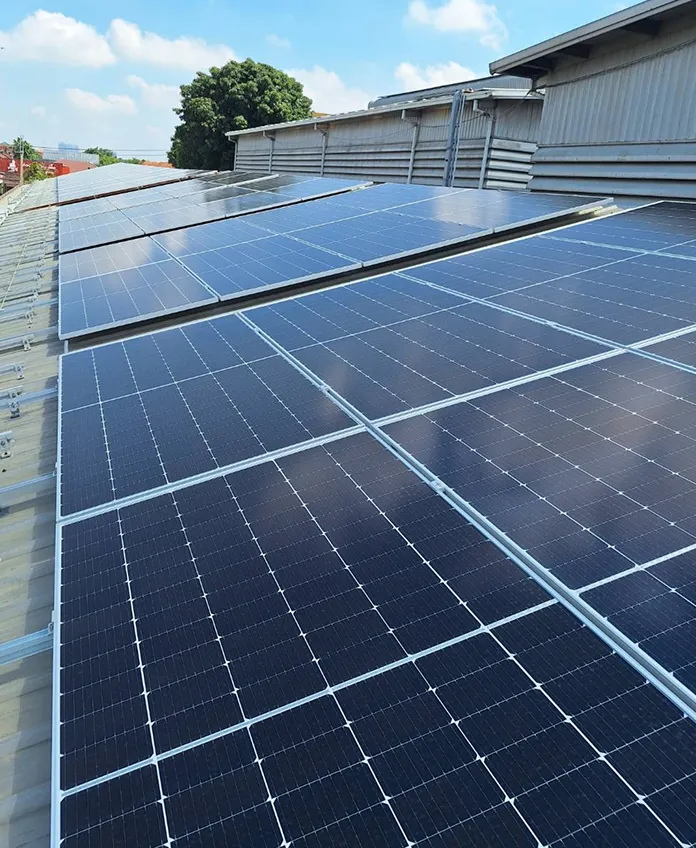
- Operating Solar Private Power Purchase Agreement (Private PPA) businesses by installing solar rooftop systems and providing maintenance services throughout the contract period. This generates and sells electricity to business sectors and industrial factories with high energy consumption at no cost for installation, resulting in lower electricity expenses and reduced greenhouse gas emissions for consumers.
- Expanding the Private PPA business model to residential housing estates and condominiums to increase access to cheaper and cleaner electricity for new customer segments.
- Operating the installation and service of Electric Vehicle (EV) charging stations for condominium projects through joint investments with project owners. This alleviates the investment burden for project owners by providing lower installation costs and enables residents to easily access renewable energy, driving sustainable greenhouse gas emission reductions in the household sector.
“Share”

- Expanding the volume and value of the Company’s climate assets, such as Renewable Energy Certificates (RECs).
- Advising the Company’s customer groups by offering carbon management services to support them in achieving their own climate change targets.
- Sharing knowledge, expertise, and experience in renewable energy with society to build awareness and correct understanding of clean energy's importance, while promoting sustainable participation in energy and environmental conservation.
Corporate Greenhouse Gas (GHG) Management
Beyond its clean energy business operations, the Company also places importance on managing greenhouse gas emissions from its operational activities. The Company systematically collects, verifies, and analyzes greenhouse gas (GHG) emissions data to evaluate operational performance and identify appropriate emission reduction measures.
The Company prepares a corporate greenhouse gas inventory and discloses emissions data in accordance with relevant reporting standards. Continuous measures are implemented to improve energy efficiency and operational performance in order to control and reduce greenhouse gas emissions within the organization, while also preparing for future disclosure requirements and evolving stakeholder expectations. To strengthen its response to climate change, the Company has established an operational framework and greenhouse gas reduction approach, focusing on the continuous reduction of emissions from internal operations. In 2025, the Company plans to further enhance its management systems and related measures to improve operational efficiency and support the long-term transition toward a low-carbon economy as follows:
Climate Change Governance
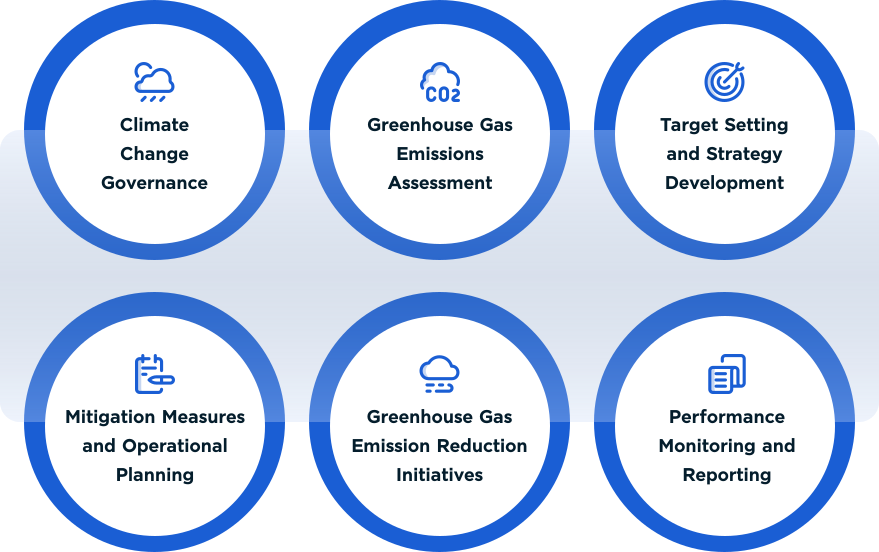
The Company integrates environmental and climate change considerations into its corporate governance framework. The Board of Directors provides overall oversight of environmental and climate-related issues and has assigned the Corporate Governance and Sustainability Committee to determine the Company’s environmental direction, strategies, and organizational targets. The Risk Management Committee, comprising members of the Board of Directors, the Chairman of the Executive Committee, and the Chief Financial Officer, oversees the management of climate-related risks and opportunities. The committee also evaluates potential impacts on business operations, monitors performance, and provides regular policy recommendations.
At the operational level, the Sustainability Development Committee has been established, chaired by the Chief Executive Officer (CEO), with the Chief Operating Officer (COO) and executives from relevant departments serving as committee members. The committee is responsible for driving environmental initiatives and climate change responses in alignment with corporate policies and targets. In addition, the Company has established dedicated working groups on environmental and climate change response, as well as a GHG inventory assessment and verification working group. These working groups implement operational plans, collect and monitor relevant data, and periodically report progress to the Board of Directors and relevant committees. Representatives from relevant departments also support the implementation of climate risk management to ensure the achievement of established targets.
Furthermore, the Company regularly reviews its environmental and climate change management policies and communicates them as internal guidelines across the organization. These policies support effective risk management and greenhouse gas reduction efforts in alignment with the Company’s business direction and stakeholder expectations.
Greenhouse Gas Emissions Assessment
The Company systematically assesses greenhouse gas emissions from its organizational activities by identifying and classifying emission sources according to their origin and emission scope. This approach enables effective monitoring and management of greenhouse gas emissions. The assessment covers the Company’s headquarters and its core business groups, including the Energy Business, Engineering and Turnkey Business, and High Voltage Equipment Business. The Company prepares a corporate greenhouse gas inventory in accordance with ISO 14064-1:2018. The inventory serves as a basis for analyzing emission trends, evaluating operational performance, and establishing greenhouse gas reduction measures on a continuous basis. To enhance data credibility, the Company engages an independent third-party organization to verify the accuracy of the data. As a result, the Company has received verification of its corporate greenhouse gas emissions for five consecutive years.
Target Setting and Strategy Development
The Company establishes short- and long-term greenhouse gas emission reduction targets in line with the Science Based Targets initiative (SBTi) to ensure clear and continuous progress in reducing greenhouse gas emissions. In 2025, the Company reviewed and updated its emission reduction targets to align with its strategic direction and operational plans. This included revising the baseline year from 2023 to 2024. In accordance with the SBTi framework, the Company has set a target to reduce Scope 1 and Scope 2 GHG emissions by 7% annually, aiming to achieve a cumulative reduction of 42% by 2030 compared with the 2024 baseline. This target supports global efforts to limit global temperature rise to 1.5°C.
Furthermore, the Company has developed management strategies to achieve these emission reduction targets in alignment with its environmental and climate change management policies. These strategies are also consistent with Thailand’s climate policy direction and international Net Zero ambitions, guided by the following operational approaches:
| Strategies | Operational Plans |
|---|---|
| Energy Saving |
Short-term (2024-2026)
|
| Renewable Energy |
Short-term (2024-2026)
|
| Low-Emission Transportation |
Medium-term (2024-2028)
|
| Sustainable Practices |
Medium-term (2024-2028)
|
| Sustainable Supply Chain |
Long-term (2024-2030)
|
Mitigation Measures and Operational Planning
The Company has established a systematic approach to greenhouse gas emission reduction by identifying significant emission sources across its business processes, covering upstream, midstream, and downstream activities. In collaboration with relevant departments, appropriate mitigation measures and operational plans are developed for each operational area. The Company also promotes the engagement of executives, employees, and stakeholders to raise awareness and support climate-related initiatives. Greenhouse gas emissions from business activities are assessed across the headquarters and three core business groups: the Energy Business, the Engineering and Turnkey Business, and the High Voltage Equipment Business. This information is used to identify significant emission sources and establish continuous operational improvement measures to reduce greenhouse gas emissions.
Greenhouse Gas Emission Reduction Initiatives
The Company implements greenhouse gas (GHG) emission reduction initiatives in accordance with established operational plans. Key performance indicators are established to monitor the effectiveness of mitigation measures for each activity. The effectiveness of emission reductions is evaluated at both the activity and corporate levels and compared with established targets. The results are used to support continuous operational improvements. Furthermore, performance is periodically monitored and reported to executive management to evaluate the success of these initiatives and enhance the efficiency of GHG reductions, ensuring the sustainable achievement of corporate targets.
In addition, the Company prioritizes building external partnerships to scale up climate change initiatives at the industry level. To this end, the Company has joined the Thailand Carbon Neutral Network (TCNN) as a "Climate Action Initiator" member. This membership reflects the Company’s unwavering commitment to driving the nation's carbon neutrality goals through knowledge exchange, the sharing of best practices, and collaboration with various sectors to tangibly reduce greenhouse gas emissions and mitigate the impacts of climate change.
Greenhouse Gas Emission Reduction Performance


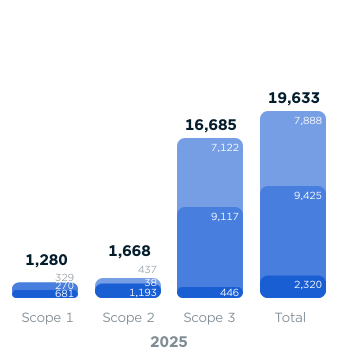
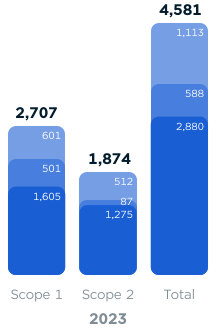
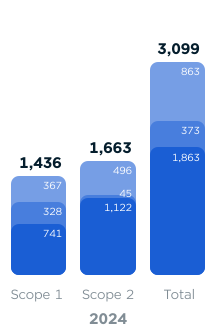
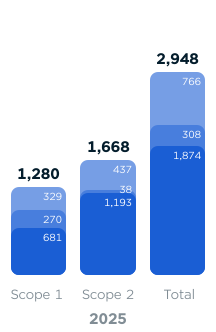
the Company assessed and verified its greenhouse gas (GHG) emissions across 22 subsidiaries within its three core business groups in accordance with the ISO 14064-1:2018 standard, with verification conducted by an independent third party, Bureau Veritas Certification (Thailand) Ltd. In 2025, total Scope 1 and Scope 2 emissions amounted to 2,948 tCO2e, representing a 4.87% reduction. Although this reduction fell short of the 7% target, Scope 1 emissions decreased significantly by 10.86%, driven by fuel efficiency improvements and the promotion of electric vehicle (EV) adoption. Meanwhile, Scope 2 emissions increased slightly by 0.30%, primarily due to higher electricity consumption associated with expanded corporate activities. Moving forward, the Company will urgently review existing measures and accelerate the implementation of additional renewable energy initiatives. For Scope 3, total emissions amounted to 16,685 tCO2e, representing a substantial 34.60% reduction. This decrease was attributed to effective supply chain management and an increased utilization of recycled materials within the Engineering and Turnkey Business and the High Voltage Equipment Business, reflecting significant improvements in procurement and production efficiency.
Total Corporate Greenhouse Gas Emissions (tCO2e)
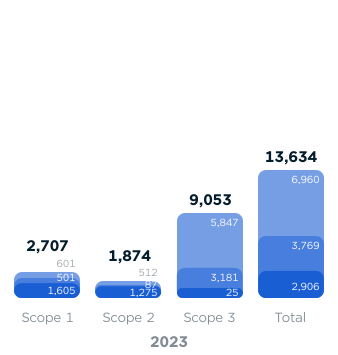
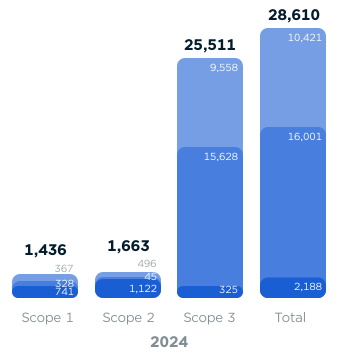
Scope 1 and Scope 2 Greenhouse Gas Emissions (tCO2e)
Scope 3 Greenhouse Gas Emissions (tCO2e)
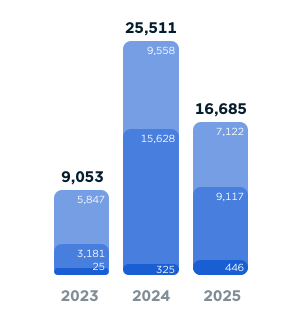

Headquarters and energy Business

Engineering and Turnkey Business

High-Voltage Electrical Equipment Business
Performance Monitoring and Reporting
The Company continuously monitors and evaluates the effectiveness of its greenhouse gas emission reduction measures and operational plans. Emission reductions are assessed at both the activity and corporate levels to benchmark performance against established targets. This information is utilized to review and continuously refine operational plans to enhance overall efficiency. Performance results are systematically compiled, analyzed, and summarized in periodic reports presented to executive management and relevant committees. Furthermore, this data serves as a key component for consistent communication with stakeholders through the sustainability report and other corporate communication channels.
Stakeholders Directly Impacted

Employees

Suppliers

Customers

Competitors

Shareholders and Investors

Public Sector

Business Partners

Communities and Society

Our Projects
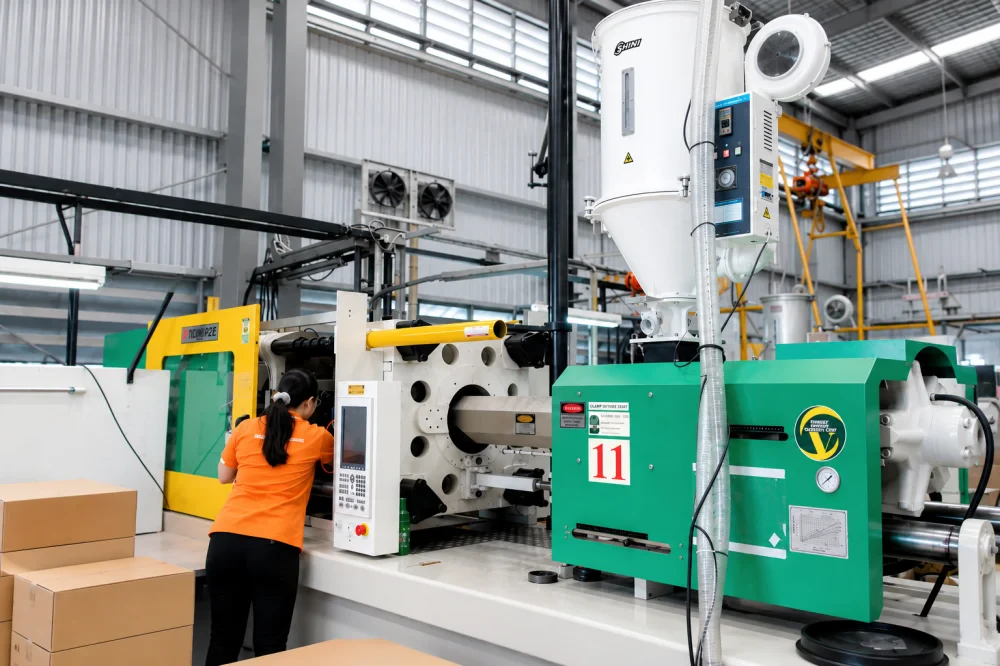
Promotion of Recycled Raw Materials in Production Processes

Eco-Friendly Employee Uniforms
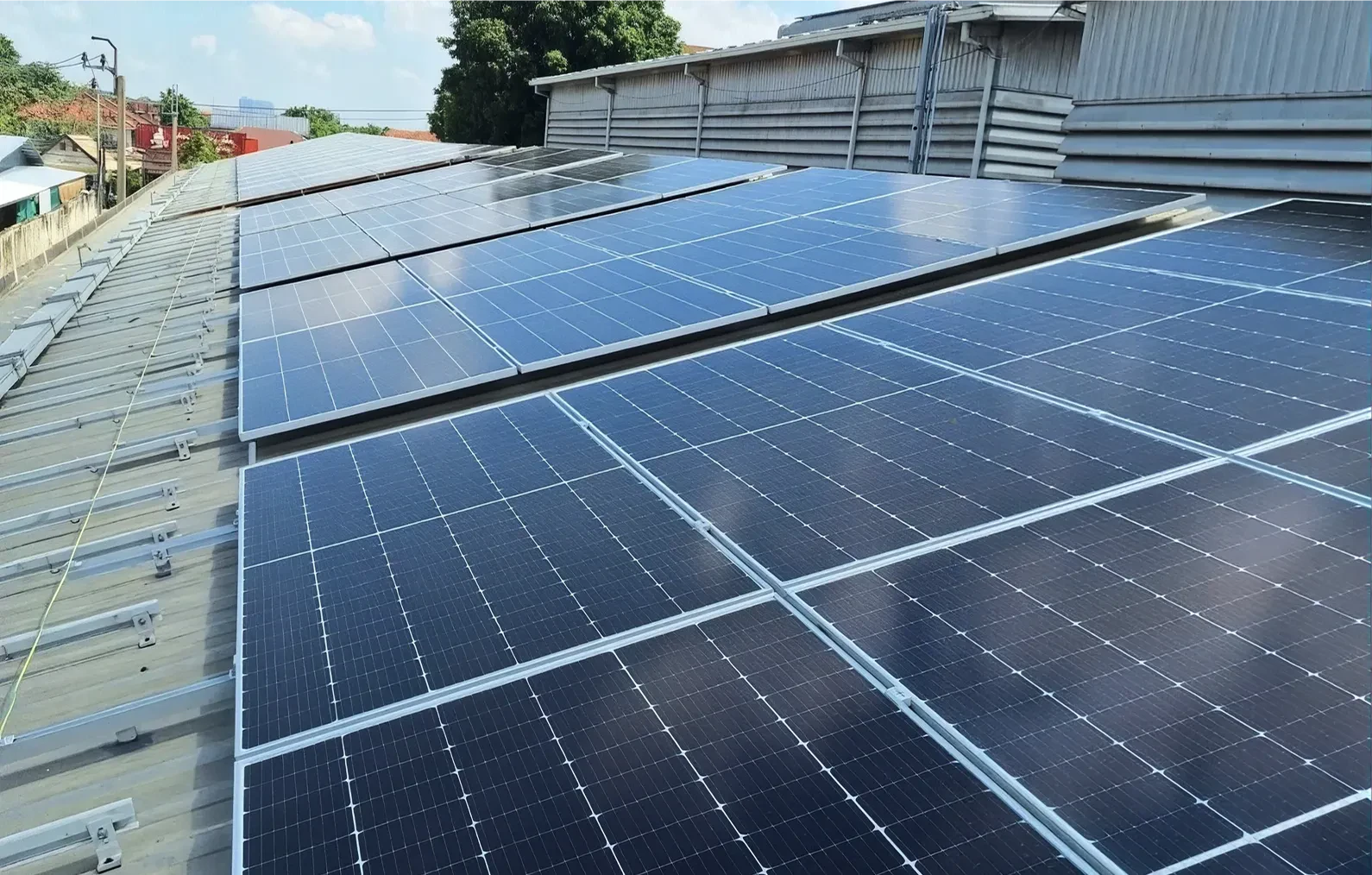
Solar Rooftop Capacity Expansion